
SoFi Personal Loan Review: Rates, Fees & Requirements
A personal loan can offer financial breathing room when credit card balances become expensive or major purchases require structured financing. However, an attractive advertised interest rate doesn’t always tell the full story. Origination charges, repayment schedules, and credit requirements can significantly influence the actual cost of borrowing.
SoFi has established itself as a digital financial institution offering unsecured personal loans with fixed interest rates and an online application process. Its financing options appeal to consumers seeking debt consolidation, home improvement funding, or more predictable monthly payments.
Before applying, it’s worth examining how SoFi evaluates borrowers, which fees may apply, and whether its lending conditions compare favorably with competing financial products.
How SoFi personal loans work in 2026
SoFi personal loans allow eligible applicants to borrow between $5,000 and $100,000 without pledging personal property as collateral. Borrowers receive approved funds and repay the principal plus interest through fixed monthly installments, generally over two to seven years.
Unlike a credit card with a revolving credit limit, an installment loan establishes a repayment timeline from the beginning. This structure can simplify financial planning, particularly for borrowers replacing several high-interest balances with one scheduled payment.
SoFi Bank, N.A., originates its personal loans and evaluates each application using financial information such as income, credit history, and repayment capacity. A borrower with excellent credit may qualify for more favorable terms, but advertised minimum rates are not available to everyone.
SoFi personal loan interest rates and borrowing costs
As of October 2, 2026, SoFi advertised fixed personal loan APRs ranging from 6.49% to 35.49%, including applicable discounts. The actual financing offer depends on the applicant’s creditworthiness, selected repayment period, and other underwriting considerations.
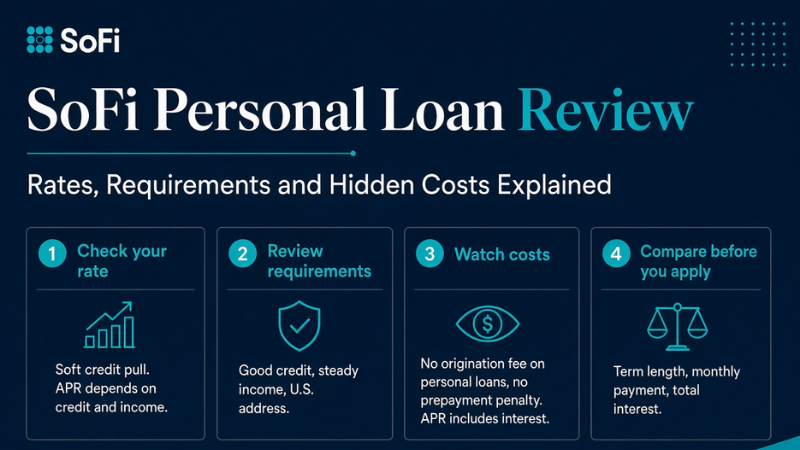
Several factors influence the final borrowing cost:
- Annual percentage rate (APR): This represents the annualized cost of credit, incorporating the interest rate and applicable origination charges. Comparing APRs provides a more useful picture than comparing interest rates alone.
- Repayment duration: Shorter terms generally require larger monthly installments but can reduce total interest expenses. Longer terms can improve immediate cash flow while increasing the overall amount repaid.
- Credit profile: Payment history, existing obligations, income stability, and available monthly cash flow help determine the terms a borrower may receive.
- Automatic payment discount: SoFi advertises a 0.25 percentage-point interest rate reduction for qualifying borrowers enrolled in automatic payments. The discount may be lost when the required payment arrangement is discontinued.
- Membership-related discounts: Eligible banking relationships or qualifying membership arrangements may provide an additional rate reduction, subject to the lender’s current conditions.
The lowest advertised APR should be treated as a possibility rather than an expectation. Applicants should compare the exact offers available to them and verify current terms on the official SoFi rates page.
Credit score and income requirements for approval
SoFi does not publish a universal minimum credit score that guarantees personal loan approval. Instead, its underwriting process examines the applicant’s broader financial profile, including credit history, income, monthly expenses, and existing financial commitments.
Applicants must generally be of legal contracting age, meet eligible U.S. residency or immigration requirements, and demonstrate employment, sufficient alternative income, or an acceptable employment offer beginning within 90 days. Documentation requirements vary by individual circumstances.
Borrowers carrying substantial credit card balances or multiple installment loans may face a more demanding financial assessment. Even with a satisfactory score, limited disposable income can affect approval decisions and available borrowing amounts.
Hidden costs and fees borrowers should examine
A personal loan may appear affordable based on its monthly payment, yet several financial details can change its overall value. In SoFi’s case, certain charges are clearly disclosed but may be overlooked by applicants concentrating on promotional rates.
Before accepting an offer, consider the following:
- Origination fee options: SoFi offers loans with origination fees ranging from 0% to 7%. When a fee applies, it is deducted from the loan proceeds. A $20,000 loan with a 5% origination charge, for example, would result in $19,000 in funds received before any other applicable adjustments.
- Cost of extended repayment: Choosing a seven-year term instead of a shorter option may reduce the required monthly installment, but interest can accumulate over a longer period. The total repayment amount deserves as much attention as monthly affordability.
- Discount eligibility: Advertised APRs may assume qualifying automatic payments or additional banking requirements. Missing those conditions can result in a higher contractual rate or the loss of an existing discount.
- Late payment consequences: SoFi advertises no late fees for its personal loans. However, overdue payments can still damage credit history, increase accrued interest, and create collection-related consequences.
- Early repayment conditions: SoFi advertises no prepayment penalties, meaning borrowers can pay down their debt ahead of schedule without a separate early payoff charge.
These are not necessarily undisclosed fees. The central risk is misunderstanding how disclosed charges, interest calculations, and repayment conditions affect the final financing agreement.
Does a SoFi banking account improve loan eligibility?
Some consumers search for sofi open account while researching personal loan approval. Opening a SoFi Checking and Savings account may provide access to financial management features and certain relationship-based benefits, but it does not guarantee personal loan approval.
The same distinction applies to a sofi joint account. Joint banking ownership is different from submitting a joint personal loan application. SoFi allows eligible applicants to apply with a co-borrower, whose income and financial profile may be considered during underwriting.
A co-borrower also shares responsibility for repayment. Both applicants should understand how the debt may affect their credit records and financial obligations before signing an agreement.
How to review and apply for a SoFi personal loan
The SoFi application process takes place online, allowing applicants to explore financing options before deciding whether to proceed with a formal credit application.
Following a structured review process can help identify unfavorable costs before a binding agreement is signed.
- Visit the official lending platform. Open the SoFi Personal Loans website and choose the option to check your rate. Confirm that the website address belongs to SoFi before entering sensitive financial information.
- Evaluate your borrowing needs. Determine the minimum amount required and establish a realistic monthly repayment budget. Borrowing more than necessary increases exposure to interest expenses.
- Provide accurate financial information. Complete the requested identification, employment, income, and borrowing details. SoFi may request additional documentation to verify your eligibility.
- Review preliminary loan offers. Checking your rate initially involves a soft credit inquiry, which does not affect your credit score. Compare available APRs, loan amounts, origination charges, and repayment terms.
- Calculate the total financing expense. Examine the complete repayment amount and net loan proceeds. Use the SoFi personal loan calculator to explore how different borrowing amounts and terms affect monthly payments.
- Complete the formal application. After selecting an offer, continue through the verification process. SoFi may perform a hard credit inquiry, which can affect your credit score.
- Read the final disclosures and accept the agreement. Verify the approved principal, APR, origination fee, monthly installments, payment dates, and funding instructions before signing electronically.
Submitting an application does not guarantee approval. SoFi reports that many applications are completed within two business days, although individual cases can require additional verification.
SoFi personal loans versus other financing options
A personal installment loan serves a different financial purpose from a business credit card or education loan. Consumers exploring a sofi business credit card should distinguish revolving business financing from fixed-term personal borrowing. Business financing may involve separate underwriting standards, expense-management features, annual fees, and credit limits.
Similarly, sofi graduate student loans and sofi private student loans address educational financing needs. They have distinct eligibility requirements, interest structures, and repayment arrangements. SoFi personal loans cannot be used to pay for post-secondary education expenses.
For debt consolidation, the comparison is more nuanced. Replacing high-interest credit card balances with a lower-APR installment loan could reduce borrowing expenses, but extending repayment over several years can offset potential savings.
Is a SoFi personal loan worth considering?
SoFi presents a competitive financing option for borrowers who value fixed interest rates, online loan management, and repayment flexibility. Its wide loan amount range and availability of no-origination-fee options may appeal to consumers financing substantial expenses or consolidating existing debt.
The potential disadvantages deserve equal consideration. Borrowers with weaker credit profiles may receive significantly higher APRs, while origination charges can reduce net proceeds. The $5,000 minimum borrowing amount may also be unsuitable for someone seeking a smaller emergency loan.
Before making a decision, compare personalized offers from multiple lenders, review all disclosures, and calculate the total cost of repayment. Consider the effect of a new monthly obligation on emergency savings and long-term financial stability.
Deixe um comentário