
IRS Refund 2026: See when your deposit might arrive
The IRS Tax Refund 2026 is eagerly awaited by millions of taxpayers in the United States, primarily those who intend to use the funds to pay off debts or strengthen their financial planning.
Organizing your credit card or reducing interest costs. Therefore, understanding the estimated repayment schedule helps the reader to better prepare, without relying on vague promises or invented dates.
The most important point is that there is no single calendar that can guarantee the exact day on which every refund will be deposited. The IRS works with average timeframes.
How does the IRS Tax Refund 2026 calendar work?
The IRS Tax Refund 2026 schedule should be understood as a forecast, not a fixed promise of deposit. When the taxpayer files the return,
This dynamic explains why two people who filed their tax return on the same day might receive their refunds on different dates. A taxpayer who uses direct deposit, has correct information, and files a simplified return may receive their refund faster.
Terms like IRS tax pay schedule, tax return schedule, and IRS refund deposit dates are frequently searched, but it’s best to use these calendars only as an initial guide.
What can speed up or delay the refund deposit?
Before looking at any estimated schedule, taxpayers need to understand the factors that influence processing. The IRS advises that delays may occur when a return requires corrections or further review.
- Electronic submission of the tax return: this is usually the fastest method, especially when combined with direct deposit into a bank account.
- Paper declaration: usually takes longer because it depends on physical receipt, sorting, and manual processing.
- Direct deposit: tends to be more efficient than a check, as it reduces the risk of loss and postal delays.
- Errors in bank details: incorrect routing number, account number, or name may prevent payment and require re-verification.
- Credits such as EITC and ACTC: those who apply for these credits may have their refunds protected by specific anti-fraud rules.
- Identity review: suspicion of inconsistency, fraud, or identity theft may result in a temporary block.
- Holidays and weekends: banks and financial institutions may not process deposits on non-business days.
Therefore, the calendar needs to be read with caution. It serves as an estimate, but it does not replace an official consultation nor does it eliminate the need for good organization of one’s financial profile.
Important dates for the 2026 fiscal season.
The 2026 tax season began on January 26, 2026, according to an official statement from the IRS. For taxpayers with EITC or ACTC, the IRS stated that it expected most refunds to be available in bank accounts or debit cards by March 2, 2026, provided the return was correct, with direct deposit and no additional issues.
This doesn’t mean everyone would receive it on that date. The IRS itself indicates that some people could receive it sooner, depending on the financial institution, while others could face review, delay, or a requirement for correction.
For those researching the IRS tax return payment schedule, it’s important to distinguish between two things: payment of taxes owed and receipt of a refund. If the taxpayer has a balance to pay, the payment schedule follows a different logic. The refund, however, depends on the approval of the amount to be received.
Estimated IRS Refund 2026 schedule by remittance type.
The table below serves as an editorial forecast based on official IRS deadlines. It does not replace consulting Where’s My Refund?, but it helps the reader to form a more realistic expectation.
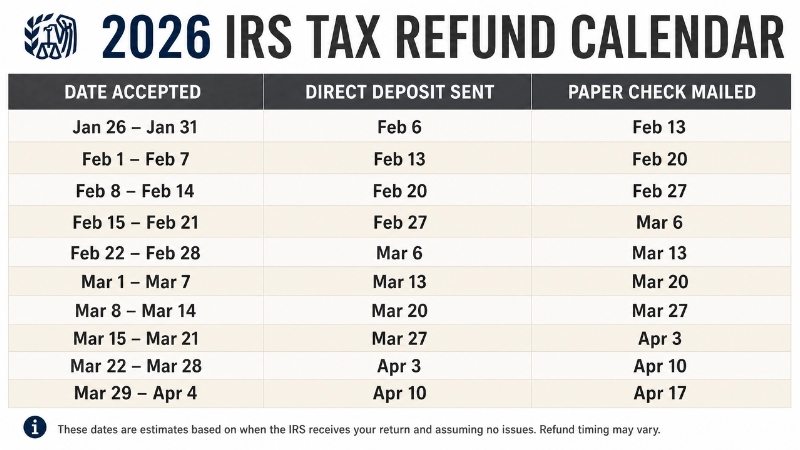
- E-file with direct deposit: in many cases, the typical processing time is around 3 weeks after electronic submission, provided the declaration is error-free and has not been revised.
- If the email file contains an incorrect bank account: the processing time may be extended, as the IRS or the bank may need to correct, reject, or reprocess the payment.
- Paper declaration: the processing time can be 6 weeks or more, especially if there is a high volume of processing.
- Tax return with EITC or ACTC: even if submitted early, payment may be delayed due to withholding rules for these credits.
- Tax return with income inconsistencies: discrepancies in W-2, 1099 forms, or dependents may require further review before approval.
- State tax refund schedule: State refunds follow each state’s own rules and should not be confused with federal refunds.
Ideally, you shouldn’t take out a loan, financing, or any other commitment with an interest rate when counting on money that hasn’t yet been confirmed.
Difference between federal refunds and state refunds
The IRS handles federal refunds. The state tax refund schedule, however, depends on the state where the person filed their taxes. Therefore, a taxpayer might receive their federal refund on one date and their state refund on a completely different one.
USA.gov recommends using Where’s My Refund? or the IRS2Go app to track federal refunds, with the system updating every 24 hours. For state refunds, taxpayers need to contact their state’s tax authority.
This distinction is crucial for those who use the money in their budget. Mixing federal and state refunds can create false expectations, especially when the reader is planning to pay off a credit card.
Step-by-step guide to checking your IRS Refund 2026 date.
The safest way to check the deposit forecast is to access the official IRS refunds page or use the IRS2Go app.
The IRS states that the status becomes available 24 hours after the electronic submission of a current year’s tax return, 3 days after an electronic return from a previous year, and 4 weeks after a paper return.
- Visit the official IRS refund page: www.irs.gov
- Have the correct information ready: the system asks for your SSN or ITIN, filing status, and the exact refund amount in whole dollars.
- Check if the declaration has already been accepted: if you just submitted it, wait the minimum processing time before checking.
- Choose the correct fiscal year: those who filed a late return or corrected information may get confused when consulting the wrong period.
- Read the status carefully: Return Received indicates receipt, Refund Approved indicates approval, and Refund Sent indicates payment has been sent.
- Compare with your bank account: even after Refund Sent, the bank may take a short period to process the credit.
- Check once a day: the system is updated every 24 hours, so repeating the query several times on the same day usually doesn’t yield any new information.
- Keep important records: save receipts, submitted statements, and official messages to facilitate any future corrections.
This monitoring prevents impulsive decisions and reduces the risk of fraud. A refund can be useful for financial planning, but should only be included in the budget once there is official confirmation.
What to do if the deposit doesn’t arrive on the expected date?
If the IRS indicates “Refund Sent” and the money doesn’t appear immediately, the first step is to check the bank details provided on your tax return.
An incorrect number can prevent the deposit or lead to rejection by the financial institution. It’s also worth remembering that banks don’t process all payments on weekends and holidays.
If the delay continues, the taxpayer should seek guidance through official channels, without providing SSN, ITIN, or bank details on unknown websites.
How to use the refund calendar without compromising your budget.
The IRS Refund 2026 can help during important times, but it should not be treated as approved credit, overdraft protection, or guaranteed income before the deposit.
The safest strategy is to list your priorities: debts with high interest rates, essential bills, emergency fund, outstanding taxes, and expenses that truly improve your financial profile.
Ultimately, the IRS Tax Refund 2026 calendar is an organizational tool, not an absolute guarantee. Use the official deadlines as a reference; consult Where’s My Refund?
Deixe um comentário